#IDFORUM2023
  • IDForum 2023
    • Background >
      • Team
      • Contributors
      • Participants
  • Programme Outcomes
  • Evaluation
Picture

ID FORUM REPORT

The #IDForum2023 was a space to reflect, share practices, tools and resources, and discuss strategies for driving more inclusion and diversity into the EU Youth Programmes..

At the #IDForum2023 participants had the opportunity to co-create this space for stories, inspiration and togetherness in line with its objectives:
Picture: celebrate logo
Celebrate together what has been achieved in the current EU youth programmes
Picture: inspire logo
Find some inspiration from others’ practices and projects
Picture: get ready! logo
Look ahead to future challenges and opportunities to drive more inclusion into the EU youth programmes
Picture
  • Check out the sessions  in the final agenda. Click on the arrows for more pages and days.
  • Click on the tabs for descriptions and reports of the sessions.
  • Click on the infographics for a larger view. 
ID Forum programme participants by SALTO Inclusion&Diversity
Picture
  • DAY 1
  • ID PEOPLE
  • ID MINDSET
  • ID CONNECTIONS
  • REFLECTION
<
>

DAY 1 - Celebrate together

​Arrivals Day
  • Settling In and Individual Exploration of Bucharest:  An activity to connect with other participants, the ID topic and a bit of Bucharest before dinner.
  • 3-2-1 ID Kick-Off Evening: An informal kick-off of the event a moment to break the ice within the group, to get to know each other and to connect to our host environment, Romania/Bucharest, through evening conversations.
Day 1 was focused on celebrating achievements  in the current EU Youth Programme
  • ID People: Welcoming the group to each other and the working space, presenting the topic of inclusion and diversity, while experiencing what makes an inclusive learning process.
  • ID Motivation &  Mindset: Exploring our personal motivation and mindset when it comes to inclusion and diversity in our lives and work, and introducing SALTO's Roadmap tool for evaluating and ensuring implementation of I&D across our organisations.
  • ID Connections: Sharing and Celebrating our Work: A self-navigated sharing and networking process with multiple stations that allowed for discovering EU programmes and ID projects, resources and partnerships.​​
  • Marketplace: A meeting point for different stakeholders to learn about each other's work, network and look into possible synergies.
  • Evening programme - Drumming for celebration:  Storytelling in different national languages  + sign language and drumming to support the story.
Picture

Opening

The Forum was opened with speeches by:
Sophia Eriksson Waterschoot, director of the ‘Youth, Education and Erasmus+’ Unit 
Picture
Monica Calotă -  Director - ANPCDEFP, Bucharest, Romania ​
Picture

After the official opening the Objects of Inclusion activity set the stage for the ID Forum, allowing participants to connect and express themselves through meaningful objects. In a brief but engaging introduction, the team shared objects or emotions, followed by grouping participants. Each person presented their object, sharing their identity, views on inclusion and diversity, and expectations for the ID Forum. Collaboratively, groups distilled their common ground into a motto or message, promoting the spirit of the ID Forum 2023. Finally, the session concluded with the groups sharing their inspiring messages, emphasizing the collective goals and aspirations of the participants.

ID Mindset & Motivation

Through the  Personal Roadmap activity, participants embarked on a journey of self-reflection and introspection. Through a visual storytelling approach, they traced the path of their lives, exploring the influences, motivations, and experiences that led them to be involved in inclusion. Each participant received a piece of cardboard to depict their reflection as a metaphorical roadmap, representing different aspects of their journey. In small groups, they shared and discussed their personal roadmaps, fostering meaningful exchanges and connections. The Personal Roadmap activity served as an introspective and interactive component at the opening of the event, promoting self-reflection, dialogue, and connection among participants.


This was followed by Tony Geudens, project officer at  Salto Inclusion & Diversity,  who presented A road map to more and better inclusion:  a comprehensive, interactive ID Road Map that helps you/us reach important milestones on the road to more and better inclusion. A handy tool to move ID forward.

Presentation available for download: 
id_roadmap_presentation_id_forum.pptx.pdf
File Size: 1347 kb
File Type: pdf
Download File

Picture
ID Connections: Marketplace
Picture
ID Connections: Sharing and Celebrating our Work was an immersive and self-guided networking experience at the event. Multiple stations were set up, each offering unique opportunities to explore EU programmes, ID projects, resources, and partnerships. Participants started at the base station for guidance and maps, then engaged in activities like Appreciative Inquiry Human Bingo and ID Check-in. They also had access to an ID Library with publications and a multimedia corner. Project presentations, testimonials, and an explanation of the ID roadmap provided valuable insights. The ID Art for Achievements station celebrated accomplishments through a collaborative collage. A designated self-care space provided solace amidst the bustling atmosphere.

Finally, the ID Marketplace facilitated connections and collaborations, as a meeting point for different stakeholders to learn about each other's work, network and look into possible synergies. 
​
Click on the titles + for further details
YILDIRIM BEYAZIT UNiVERSiTY (ANKARA, TÜRKİYE         
Picture
Main Activities: ​AYBU is the 97th university in Türkiye and the 5th state university in Ankara with 7 faculties, 1 vocational school, 4 graduate schools and 1 conservatory. 

Brief description: The university is offering education in 15 faculties, 1 school, 1 state conservatory, 3 vocational schools, 5 graduate schools and 24 application and research centres. More info

For Whom? Educational difficulties, Cultural differences, Economic obstacles, Geographical obstacles

More info: 
https://aybu.edu.tr/ 
IDENTITY.EDUCATION (TIMISOARA, ROMANIA)
Picture
Main Activities: ​We organize events and cultural and artistic activities that bring the LGBTQIA+ community closer to Timișoara’s citizens. We are here as a formal representation of the community and the needs of the LGBTQIA+ community in western Romania.

Brief Description: We know how important a sense of belonging is, and we know how hard it is to find people who truly understand you. We thus create safe spaces for the local LGBTQIA+ community, where we organize events, discussion spaces or simply a place where the LGBTQIA+ community can feel safe. The PrideTM Center is a physical place in Timișoara that serves as a meeting place for the LGBTQIA+ community. 

For Whom? Cultural differences, Social obstacles

More info: 
https://identity.education/​
IBB E.V. (DORTMUND, GERMANY)
Picture
Main Activities: Civic and historical education, International Youth Work, Diversity Work in the Health Sector

Brief Description:  "Generation Europe" fosters cross-cultural exchange and civic education for European youth, emphasizing inclusion of underprivileged groups. It provides opportunities to enhance skills by participating in international programs, overcoming language/financial barriers through targeted support. They return home as ambassadors of European understanding, continuing to work in local groups for 3 years.

For Whom? Health problems, Educational difficulties, Cultural differences, Economic obstacles, Social obstacles, Geographical obstacles

​
More info: http://www.generationeurope.org/​
STAMILY (THE NETHERLANDS)
Picture
Main ​Activities: Stamily's motto is: Immerse yourself in a world narrated by people who stutter. We organize youth exchanges, are in involved in strategic partnerships and organize regularly live meetings for persons who stutter.

Brief Description:  The association 'Stamily' started after an international youth exchange for young persons who stutter in 2017 and now we organize national and international meetings for al persons with a stutter all over the world. We organize youth exchanges, are in involved in strategic partnerships. We wrote a manual about how can deal with stuttering in Youth Work: https://stamily.org/manual/
​

For Whom? Disability, Health problems

​
More info: https://stamily.org/​
STICHTING ANATTA FOUNDATION (THE NETHERLANDS)​
Picture
 Main Activities:  The Anatta Foundation is is a foundation dedicated to the well-being of people and the planet. We focus on strengthening feelings of happiness, well-being and connection with nature. We work with vulnerable target groups in nature, like people with a disability or a different cultural background.

Brief Description: In all the activities that we do we find a link between nature and positive mental health development. A few of the projects include: https://positivementalhealth.eu/ and https://natureintelligence.eu/. We also organise trainings and (youth) meetings in nature. In all of our projects we try to be as inclusive as we can to persons from different backgrounds.

For Whom? Disability, Health problems, Cultural differences, Social obstacles, Geographical obstacles

​
More info: https://anattafoundation.org/​
JUGEND EINE WELT / WELTWEGWEISER - SERVICESTELLE FÜR INTERNATIONALE FREIWILLIGENEINSÄTZE
Picture
Main Activities: WeltWegWeiser is a service information platform for young people interested in volunteering abroad and also a cooperation network for currently 16 Austrian voluntary service organizations, that aim to provide volunteer opportunities of good quality.

Brief Description: With the EU-funded project “Inspired by Inclusion” we developed together with our partners several educational materials for inclusive volunteer services. At the moment we are working on a project called Green Diversity.

For Whom? Disability, Health problems, Social obstacles

More info: www.weltwegweiser.at  www.jugendeinewelt.at
MASTERPEACE (UTRECHT, THE NETHERLANDS)
Picture
Main Activities: Our mission is to connect, support and strengthen CSOs for more social impact and share and scale innovative best practices to engage, connect and empower young people locally to use their talents for a peaceful, inclusive & sustainable future.

Brief Description: We work with different projects like ACT! as a Doughnut (based on Doughnut economics) and ACT! in Education. where we boost the positive and active participation of youngsters and enable them to grow their talents and become an active citizen in order to create a sustainable future in their local community based on shared values.

For Whom? Educational difficulties, Cultural differences, Economic obstacles, Social obstacles

​
More info: https://masterpeace.org/​
GIGOS VZW (GENK, BELGIUM)
Picture
Main Activities: Organise activities to have fun, but most importantly to learn something. Each age we have here, has different goals.

Brief Description: We focus on youth who are in a difficult social environment. The're a lot of cultural differences and they don't get all the chances to evolve themselves. We as professionals create an environment for them to explore themselves.

For Whom? Educational difficulties, Cultural differences, Social obstacles

​
More info: https://gigos5.webnode.nl/​
ROOTS (FLANDERS, BELGIUM)
Picture
Main Activities: Roots is a network organization that supports and represents broad youth initiatives with expertise in supporting initiatives for socially vulnerable young people from various disadvantaged groups 

For Whom? Educational difficulties, Cultural differences, Economic obstacles, Social obstacles

​
More info: http://www.roots-vlaanderen.be/​
AMAIS (BUCHAREST, ROMANIA)
Picture
Main Activities: We are creating an equitable society for people with temporary or permanent disabilities by applying the principles of inclusive design in: architecture,tech,social projects.

Brief Description: https://amais.ro/proiecte/spatii-publice-fara-bariere/​

For Whom? Disability, Inclusive design

​
More info: https://amais.ro/​
ASOCIATIA DOWN ACTIV MOLDOVA (BOTOSANI, ROMANIA)
Picture
Main Activities: Promoting social inclusion and increasing the quality of life of people with disabilities.

Brief Description: Our vision is that of a world where children, young people and adults, regardless of disability, have equal chances to reach their potential, to grow harmoniously, a society that respects the right to be different, unique and valuable, a community which values ​​values ​​such as children and family, belief in the victory of good, human dignity, equality and trust.

For Whom? Disability 

​
More info: https://downactivmoldova.com/​
FORUM FOR QUALITY FOSTER CARE OF CHILDREN (ZAGREB, CROATIA)
Picture
Main Activities: Main activities include educational, creative and supporting workshops for foster children, foster parents and experts in the field. Promoting foster care and working with the Ministry in the process and developing and bettering the system of foster care.

Brief Description: All of our work is based on the needs of our target population (children in foster care and foster parents), and all the topics that we as experts cover in our direct work with them is based on recognizing those needs and developing methods to help them overcome it. Also, we are here to introduce policy makers, stakeholders and public on the topic to help bring awareness to this population.

For Whom? Cultural differences, Social obstacles, Without adequate parental care

​
More info: https://udomiteljizadjecu.hr/​
"CHANGING MYSELF...I CHANGE THE WORLD" (VOLOS, GREECE)
Picture
Main Activities: Activities in the field of educational and social inclusion of disabled youth

Brief Description: The organization aims to promote the continuous improvement of education and social inclusion of people with disabilities. Our goal is to teach people with disabilities new skills to become as autonomous as possible.
​

For Whom? Disability, Health problems

​
More info: https://allazoemenakaitonkosmo.com​
AĠENZIJA ŻGĦAŻAGĦ (ST VENERA, MALTA)
Picture
Main Activities: Aġenzija Żgħażagħ's main services are the Regional Youth Services, the Inclusion, transition and employment programme and Empowerment programmes.

Brief Description: The practice of inclusion is visible through every service provided by the Agency. Inclusion ensures that all young people coming from different socio-economic background and having different abilities can reach their full potential. This practice is mostly implemented in the youth cafes, youth hubs in schools, and life skills programmes.

For Whom? Disability, Educational difficulties, Cultural differences, Economic obstacles, Social obstacles

​
More info: https://youth.gov.mt/​
KAHRAMANMARAŞ SÜTÇÜ İMAM UNIVERSITY (KAHRAMANMARAŞ, TÜRKIYE)
Picture
Main Activities: Kahramanmaraş Sütçü İmam University was founded in 1992 in Kahramanmaraş and has adopted the principle of maintaining high education / training standards with social, scientific and cultural activities by renewing and improving itself day by day since the day it was founded.

Brief Description: So far 1627 scientific projects have been conducted and more than 400 social activities hosted at our university only last year. Also we are Eurodesk Contact Point and we try to make our students informed about the social projects,and EU projects and also encourage them to take part in both social and academic projects. We were awarded as ESC Lead Organization and Erasmus Accreditation in Youth.

For Whom? Cultural differences, Economic obstacles, Social obstacles, Geographical obstacles

​
More info: https://www.ksu.edu.tr/​
MALTA CHAMBER OF SCIENTISTS  (MALTA)
Picture
 Main Activities: Our ultimate goals are to improve science awareness and develop informed opinions, increase student uptake of STEM careers for high-level jobs, stimulate the socio-economic wellbeing of partner countries, and enhance the transferable skills of current researchers.

Brief Description: Our initiatives related to Inclusion and Diversity; Women in Science: https://mcs.org.mt/what-we-do/funded-projects/ and Equal by Nature: https://mcs.org.mt/equal-by-nature/

For Whom? Cultural differences, Gender-based barriers

​
More info: https://mcs.org.mt/​
TUMULT (MECHELEN, BELGIUM)
Picture
Main Activities: - summer camps - animator course (training to become a volunteer) - going abroad - project 'Ananas' for young refugees - trainings for other organisations - Build a bridge to a broad free time context for young newcomers.

Brief Description: To be able to do all these activities Tumult counts on volunteers. About half of our volunteers was not born in Belgium. We achieve a unique cultural mix where volunteers can explore their talents and develop them. We also try to support other organisations with our expertise. For example, we did a project with young people who had fled from ukraine to become starters in Belgian youth work.

For Whom? Cultural differences, Economic obstacles

​
More info: https://tumult.be/​
Volunteers' Centre of Vojvodina (Novi Sad, Serbia)
Picture
Main Activities: Volunteering, activism, awareness-raising, participation, regional cooperation and reconciliation, permaculture, workcamps

Brief Description: We also deal with ESC and promotion of ESC within youth and CSOs in Serbia, and we would like to make our ESC practices more inclusive.

For Whom? Cultural differences, Social obstacles, as well as mainstream youth

​
More info: http://volontiraj.rs​
​​Bagázs Közhasznú Egyesület (Bagázs Public Benefit Organisation) (Bag and Dány, Hungary)
Picture
Main Activities: Bagázs is a public benefit organisation that has been working since 2011 to contribute to an inclusive society in which Roma people have a chance to achieve their goals. The primary aim of our programs is the development and empowerment of the local community through our presence in the settlements.

Brief Description: We are working to eliminate socio-cultural disadvantages of people living in settlements. This can only be achieved if we jointly set up changes in the community and in the majority society. We seek to make the Roma people more capable, while making the people belonging to the majority society more accepting. Our programs are based on local needs, so they are constantly adapting to the community.

For Whom? Educational difficulties, Cultural differences, Economic obstacles, Social obstacles, Geographical obstacles

​
More info: https://bagazs.org/​
​Las Niñas del Tul, (Granada, Spain)
Picture
Main Activities: Youth work and European programs.

For Whom? Cultural differences, Economic obstacles, Social obstacles, Geographical obstacles

​
More info: http://lasdeltul.net/​
Children's rights KnowleDGe Centre (Ghent, Belgium)
Picture
Main Activities: Spreading information on children's rights for policy makers, youth workers and schools etc.

Brief Description: We are a collaboration between all the policy organisations in Flemish youth work. We don't do the practical work, but function as a platform to gather information, questions and good practices for more inclusive youth work for the entirety of Flanders and Brussels, in accordance of the ministry.

For Whom? Disability, Health problems, Educational difficulties, Cultural differences, Economic obstacles, Social obstacles, Geographical obstacles

​
More info: https://komaf.be/nl​
The Finnish Roma Association (Helsinki, Finland)
Picture
Main Activities: The Finnish Roma Association promotes Roma human rights, increases Roma people’s active participation and builds their leadership.

Brief Description: The main target groups include the elderly Roma, Roma women in their active ages and Roma youth. The skills and capacities of Roma for social participation have been strengthened by training on human rights, intersectionality, Roma policy, anti-Gypsyism, and others. An internship program has been established to improve the working life readiness and further employment opportunities of the Roma.

For Whom? Cultural differences

​
More info: https://www.suomenromaniyhdistys.fi/​
Sivas Gelisim Genclik Dernegi (Sivas, Turkey)
Picture
Main Activities: Youth works, education, democracy, human rights, inclusion, ecology, refugees, unemployment, sports and culture.

Brief Description: Our main activities are based on intercultural learning, by using a non-formal education and youth activities in order to encourage the youth participation in the international context. Our organization wants to encourage youth initiatives by young people. We support them by providing information, tools, and training to help them get their goals. 

For Whom? Cultural differences, Economic obstacles, Social obstacles

​
More info: http://www.gelisimgenclik.org​
ID Connections: Reflections
The marketplace  was followed by both  group and individual reflections of the experience throughout the day, and peer sharing. 
​
Click on the titles + for further details
Group Reflection: "OUR ORGANISATIONS AND THE RESOURCES / NETWORKS THAT SUPPORT US"
Missing elements for supporting organizations in the field of youth work:​
Funding:
- There is a need for long-term funding to support organisational capacity building and address various issues.
 
Programmes:
- Youth-friendly and youth with special needs-friendly opportunities are desired, including simplified application processes and individual reports.
- Flexibility in programme design and more clarity on the application of basic laws and human rights are important.
 
Resources:
- Organizations seek guidance on finding available resources and access to experienced staff.
- Inclusive IT tools and technology infrastructure are needed for effective work.
- The use of SALTO ID web for tools and project-building events is recommended.
 
Outreach & Dissemination:
- Local support and a vision within public administrations are necessary.
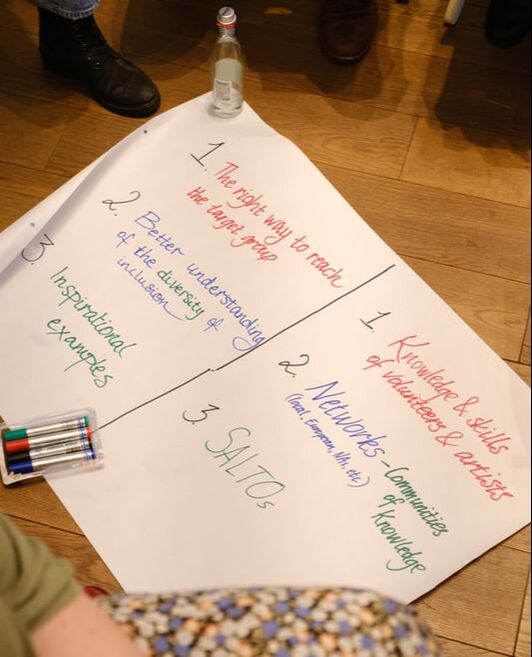
- Effective strategies to reach the target group, better understanding of diversity and inclusion, and inspirational examples are required.
- There should be a better understanding of the local community and a focus on creating visible impact.
- Outreach efforts should target young people who are not accessing existing programs.
 
System-level Issues:
- Stability, both economic and political, is crucial for supporting organisations in the long run.
- A platform for systemic change, learning, ideas, and support is needed.
- Motivated youth and platforms for young voices should be created.
- Open discussions in public spaces and critical thinking in education are valued.
- The establishment of a European federation of youth workers for recognition and strategic communication among NGOs and inter-organisational interactions is desired.
- There should be a safe environment to talk about human rights, sex education, and other sensitive topics.
 
In summary, organisations in the field of youth work require long-term funding, youth-friendly programmes, access to resources and experienced staff, effective outreach and dissemination strategies, and systemic support for stability and change. There is a need for improved communication, understanding of diversity and inclusion, and platforms for young voices. Additionally, there should be an emphasis on critical thinking, open discussions, and safety in addressing sensitive topics.
existing resources and networks that support the work of the organisation
​Networks:
- Networks play a crucial role in supporting the work, as they are mentioned multiple times and are highly valued by the participants.
 
Programmes:
- The Erasmus+ and European Solidarity Corps (ESC) programmes are widely recognized and appreciated for their diversity and the opportunities they provide, though there is a suggestion for further diversity in available programmes.
- There is recognition of the resources and ideas provided through these programmes.
 
Accreditation:
- SALTO (Support, Advanced Learning, and Training Opportunities) is highly regarded and mentioned several times, indicating its significance in supporting the work.
 
Training and Networking:
- Training opportunities and networking events are considered valuable for knowledge and skill development.
- The National Agencies (NAs) associated with these programmes are recognized for their contributions and support.
 
Inclusion and Diversity:
- There is recognition of the importance of inclusion and diversity (I&D), and it is acknowledged as a regular priority with extra funding allocated to it.
- The need for finance to support inclusion-specific activities is mentioned.
 
New Ideas and Opportunities:
- The Erasmus+ programme is seen as providing new ideas and opportunities.
 
Target Groups and Initiatives:
- Recognizing and addressing the specific needs of target groups through the Erasmus+ and ESC programmes is viewed as a positive step.
- Youngsters taking their own initiatives and schools promoting voluntary work are seen as contributing to the overall support for the work.
 
Advocacy and Protective Laws:
- There is mention of protective laws for LGBTQIA+ individuals and the role of NGOs in pushing agendas related to inclusion and diversity.
 
In conclusion, the comments highlight the significance of networks, programmes like Erasmus+ and ESC, accreditation through SALTO, training, and networking opportunities. Inclusion and diversity are recognised as important priorities with dedicated funding. The participation and initiatives of young people, as well as the promotion of voluntary work in schools, are seen as positive factors. Advocacy efforts and protective laws are also acknowledged.
Picture
Individual Reflection: TODAY'S DISCOVERIES  AND TAKEAWAYS
Picture
new things you discovered today
I&D Movement and Collaboration:
- Participants noticed a significant movement around inclusion and diversity (I&D) across various contexts, indicating a growing awareness and engagement in these areas.
- The potential for network and collaboration opportunities emerged, suggesting that participants discovered the power of working together towards common goals in I&D.
 
Grassroots Actors:
- Participants recognised the impact and effectiveness of grassroots actors when they align their efforts towards a shared direction in promoting inclusion and diversity.
 
SALTO I&D Roadmap:
- The SALTO I&D Roadmap was discovered and likely explored by participants. This resource likely provided valuable guidance and insights related to inclusion and diversity work.
 
Resources:
- Participants came across valuable resources related to inclusion and diversity, indicating the discovery of tools, information, or support that can enhance their work in these areas.
 
Work of Different Organisations:
- Participants became aware of and gained insights into the work of various organisations, suggesting exposure to diverse perspectives and approaches in promoting inclusion and diversity.
 
Good Vibes:
- Participants experienced positive and uplifting energy or atmosphere, denoted as "good vibes" during the event or their interactions with others. 
 
Similar Issues:
- Participants found that they share common challenges or issues with other individuals or organisations working in the field of inclusion and diversity. 
 
Projects:
- Participants learned about different projects related to inclusion and diversity, indicating exposure to innovative ideas and practices that can inspire their own work.
 
In conclusion, participants discovered a vibrant I&D movement, recognized the power of grassroots actors, explored the SALTO I&D Roadmap, accessed valuable resources, learned about the work of different organizations, experienced positive energy, identified shared issues, and discovered inspiring projects. These new discoveries likely enriched their understanding, expanded their networks, and provided insights and inspiration for their future work in promoting inclusion and diversity.
Ideas that you can take back and practically implement in your daily work
​Improving the Network:
- Participants recognised the importance of improving their network, indicating a desire to establish or strengthen connections with relevant individuals or organizations. 
 
Knowledge, Resources, and Tools:
- Participants identified the need to translate knowledge, resources, and tools into practical action. While they may have acquired valuable information during the event or through the SALTO I&D Roadmap, the focus is on implementing these resources effectively in their daily work. 
 
More Work:
- The idea of "more work" signifies participants' recognition that further efforts are required to drive meaningful change in their respective fields. 
 
SALTO I&D Roadmap:
- Participants acknowledged the value of the SALTO I&D Roadmap as a practical resource. They likely intend to utilise the Roadmap to guide their work, incorporating its strategies and recommendations into their daily activities. 
 
Connections:
- Participants emphasised the significance of building connections, indicating a desire to establish meaningful relationships with individuals or organisations. 
 
In conclusion, participants are determined to improve their network, translate knowledge into action, invest more effort, leverage the SALTO I&D Roadmap, and establish connections. These conclusions highlight their intention to implement practical strategies, utilise available resources, and collaborate with others in their daily work. By taking these steps, participants can effectively promote inclusion and diversity, bringing about positive change in their respective spheres of influence.
Picture
  • DAY 2
  • ID STORIES
  • ID SKILLS - WORKSHOPS
  • ID QUEST - FIELD VISITS
<
>

DAY 2 - Find inspiration

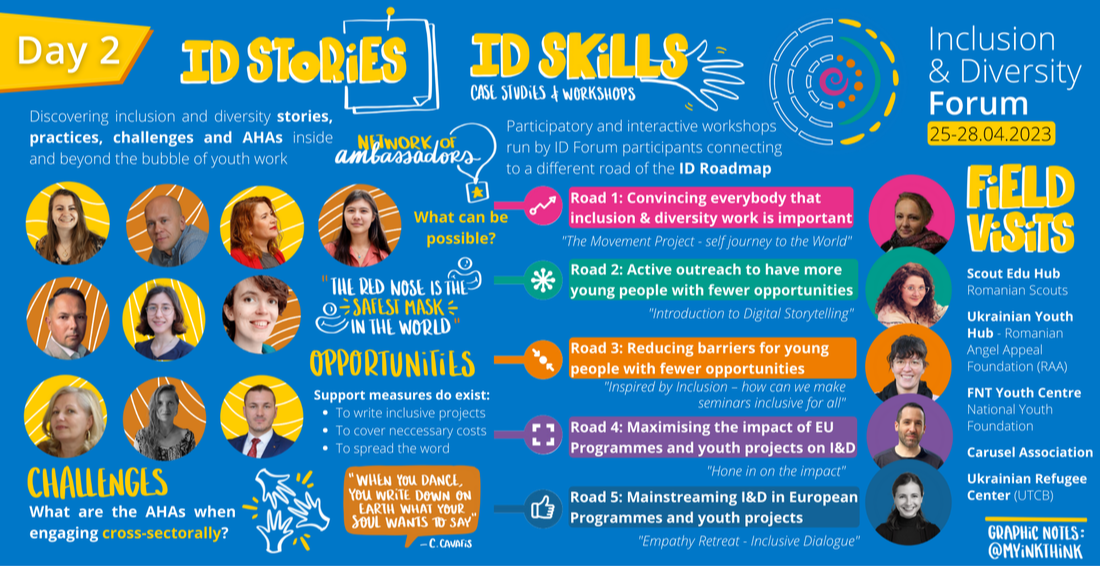
Day 2 of the programme was devoted to finding inspiration from various sources  - people, cases, and organisations
  • ID Stories -  Being Part of Something Bigger Beyond the Bubble:  A session on discovering inclusion and diversity stories, practices, challenges and AHAs inside and beyond the bubble of youth work. Participants and external guests coming or having experience in different sectors shared their stories  followed by a co-created reflection on what can be possible, what are the challenges and what are the AHAs when engaging cross-sectorally.
  • ID Skills: Case Studies and Workshops: Participatory and interactive workshops run by ID Forum participants, sharing skills with other participants and celebrating successful initiatives through experiential learning, categorised by the 5 roads of the SALTO ID Roadmap.​​
  • Field visits: participants were divided in groups and visited different hubs that conduct activities for Ukrainian refugees. Each of the groups familiarized with one project and supported the hosting organisation in solving a challenge related to their activity.
Picture

ID Stories

Picture
The session titled "Introducing the ID Stories" brought together guests and participants from various fields, including Business, Research, Tech, Formal Education, Art, Politics, and Activism. Each story began with the storyteller introducing themselves, sharing their professional background, and their experiences in a specific field. They highlighted both possibilities and challenges encountered when engaging with ID youth work. After the introductions, participants had 2 rounds of in-depth explorations with each story. In the end, everyone gathered in a plenary session to create a collective reflection called the "Breaking the Bubble storyline." Using the Mentimeter platform, participants contributed line by line to build a story, sharing their insights, a-ha moments, and creative thoughts. 

​
Click on the titles + for further details
Josip Luša
Picture
Josip Luša - SALTO Inclusion and Diversity (Education and Training), Zagreb, Croatia
​

Brief Description:  My name is Josip and I've been in and around Erasmus+ since 2015. Having started out in the field of vocational education and training, I’m now in the SALTO team and committed to implementation and development of various activities and outputs (trainings, seminars, conferences, guidelines, reports, tools) that help organisations be more inclusive and diverse in their E+ projects and everyday work.

​Main Challenges and Opportunities: 
1. Understanding I&D
​a) organisation of trainings and seminars
b) development of resources, publications and e-courses
c) implementation of the mentorship programme
2. Outreach and communication
a) establishment of a network of I&D ambassadors b) resources and publications
3. Mainstreaming I&D
a) design and launch of awareness-raising campaigns
b) cooperation with other interested stakeholders
Session Report  - Rapporteur 
Marija Kljajic    
 
Topic
Josip has been in and around Erasmus+ since 2015. Having started out in the field of vocational education and training, he is now in the SALTO team and committed to implementation and development of various activities and outputs (trainings, seminars, conferences, guidelines, reports, tools) that help organisations be more inclusive and diverse in their E+ projects and everyday work.       
 
Main points or issues
1. Understanding I&D
It’s important to broaden the definition of inclusion, as it’s often see as only disability
  • a) organisation of trainings and seminars
  • b) development of resources, publications and e-courses
  • c) implementation of the mentorship programme
2. Outreach and communication
Just having an open call is often not enough to get young people with fewer opportunities on board.
It’s important to provide additional support, involve parents, peers, etc. 
  • a) establishment of a network of I&D ambassadors
  • b) resources and publications
3. Mainstreaming I&D
  • a) design and launch of awareness-raising campaigns
  • b) cooperation with other interested stakeholders  
 
Opportunities
  • Taking part in the programmes can be a life changing experience for young people with fewer opportunities.
  • NAs offering supportive approach to organisations to write and manage the projects
  • Financial support for inclusion and exceptional costs.
  • Alternative ways of applying (like videos).
  • Network of ambassadors can help to reach out ( example of Croatian NA)
  • Being part of an wider network can help organisations to reach out to more young people, as well as using connections with municipality, creating partnerships with other local organisations etc.
  • Changing (local) polices through practices and creating coalitions of organisations working on the same issues (like foster homes – example from Croatia) by lobbying and communicating those to (local) policy makers.
  • E+ & ESC funding is in comparison with some other fundings (local/governmental) easier and less bureaucratic.
  • NAs could be organising more workshops on project writing and management.    
 
Challenges
  • To find a way to transform the programmes so that there are not “elite” clubs.
  • People are very open to work with people with disability, but it often stops there.
  • Reaching out to young people with fewer opportunities - often getting place in an international project is based on relationship with a teacher/youth worker. Also information doesn’t reach young people from small and rural places.
  • Providing right support so that young person can fully benefit from the international experience, as that can be scarry and challenging.
  • Organisations are understaffed and writing a project is not easy (terminology, knowing “the world” and the rules, requires a lot of learning and it’s time consuming) and it’s competitive.
  • Exceptional costs – sometimes not enough or organisations don’t know what’s possible to request and don’t make use of it.
  • Selection process – often it’s matter of luck not of good quality. Hard to filter good ones, it’s depending a lot on experts. Two rounds for applying are not enough. Projects like youth exchanges, written by young people with fewer opportunities are often not a best quality and not written well and often don’t go through.
  • Finding right partners for the international projects.
  • Insecure and not regular funding that organisations are (not)getting on local/national level.
  • Reporting and IT tools.
Tudor Paul Scripor
Picture
Tudor Paul Scripor - The Scripor Alphabet, Cluj-Napoca, Romania

​Brief description: The tactile alphabet of colors, known as the Scripor alphabet promotes inclusion and diversity by empowering individuals with visual impairments to efficiently identify, recognize, differentiate read, and write colors. The Scripor alphabet is based on the principles of Universal Design, enabling blind, color-blind people to live inclusively in a colorful world.

Main Challenges and Opportunities:  The Scripor alphabet enriches the Braille alphabet, providing easy access to color information for people with visual disabilities. It is universally accessible, easy to learn, practical, and inclusive. The alphabet uses one or two cells to represent color and its variations, compatible with modern technology. It can be read tactile and is suitable for all ages and levels of vision impairment.
Session Report -  Rapporteur 
Miriam Petra Ómarsdóttir Awad       
 
Topic
Scripor alphabet and its usefulness in inclusion      
 
Main points or issues
  • There was no universal colour code for colours. There are letters, numbers, punctuation etc but no colours.
  • Tudor wanted to create a colour code enriching the braille language where the combination of dots represents specific colours.
  •  Based on colour theory from art (red-yellow-blue): so the code for colours combined from two colours is a combination of the code for those two. (I.e. elements from the code for yellow and for blue, are combined in the colour green).
  • The script offers to those who have lost their vision a way to know what colours objects or clothes are.
  •  The script offers those who have never seen colour to differentiate between objects.
  • The script is also suitable for color blind people. 
  • The Scripor alphabet can represent dark shades and light shades (makes it easier for example to label things).
  • Scripor color code breaks language barriers because people don't need to understand each other’s braille way of spelling different colours to understand them.
  • The app uses AI to help people to recognise what color clothes match.   
 
Opportunities
  • The Scripor code can be learnt in 20 minutes from the app.
  • App teaches also things that are associated with each color.
  • Both easy for those who don't know braille – makes it easy to learn braille – but also easy for those who are using braille - as the structure is similar.
  • Can help people identify colours during games, other activities.  
 
Challenges
  • Spreading awareness of the code.
  • Not easy to have access to printers.
  • The colors are linguistically indicated in braille.
  • Socks was a big challenge so they are now making embroidery to color code socks and other adhesive labels to put on clothing, as it instills confidence.    
 
Main Takeaways
Only 10% are born blind. 90+% of people become blind later in life and remember the colors and what they look like. The code is also relevant for those who never saw colours, as they can understand which colours are associated with which things (grass, sky, etc). 
Being able to differentiate colours is an issue of inclusion: it can mean that you know how to colour coordinate your clothes, you can participate in playing games based on colours, you can recognise different objects that are normally recognisable by colours (red vs green apple, red vs. white wine, etc).
Linda Ulane
Picture
Linda Ulane - Radi Vidi Pats (Create the Environment Yourself), Liepaja, Latvia

​Brief description: People in prisons are one of the most marginalized groups. Prejudices and lack of various skills are following them after returning to freedom. I believe that it is also our responsibility to support their return by offering them healthy growth opportunities, thus creating an understanding that they are returning to our communities. And it is up to us how we want to see our communities.

Main Challenges and Opportunities: 
I haven't solved any of issues. But we are working with: - lack of various soft skills, such as communication skills; - low self-esteem; - very low emotional intelligence, that includes empathy; - hate towards the existing system; - lack of healthy creativity; - lack of opportunities. We are working on this through encouraging youngsters to volunteer in prisons and facilitate various workshops..
Session Report - Rapporteur
Tony Geudens
 
Topic
Youth work in prisons
 
Main points or issues
  • I wanted to work in a prison but it is very difficult to get in.
  • But I went to the UK to teach creative writing, I also am a ‘Doktor clown’ (cliniclown, therapeutical clown children hospital etc) = they also go into prisons on family days, to help break ice for the children visiting. The red nose is the safest mask in the world (massive freedom to break codes, to interact with strangers, in strange environments etc).
  • In Latvia, there was a programme for NEET, and they also had activities in prison (as the inmates are not in education or work). So, I did creative writing workshops for NEET. When the official programme stopped, I could do a volunteering position via her NGO.
  • Through my workshops, I accidently empowered and encouraged ‘3 freedom youngsters’ together with ‘3 prison young people’ (18+) to write a solidarity project together (funded by the European Solidarity Corps). Collecting the needs of the young people in the prison. The importance that all young people should be creators and share (not only the freedom guys, teaching the prison guys). Level of equality, bi-directional.
  • One-to-one mentoring session with a young prisoner (they mostly come to get out of the room), he wrote a letter for a school class (about his story, about his wrong choices etc). Change of energy, because it was one of the rare times that he felt useful and could share, that he could do something (in prison they normally they only follow rules/consumers – everything given for them, no choice).
  • Important not to be ‘consumers’ again – the solidarity projects focused on skills and hobbies – eg crafts, language session, etc. Everybody shared their skills. Exploring ‘what helps you learn’. They made workshops together, for both. Encourage young people (in prison and not in prison). With the money they also invited some experts (they continue working with prisons).
  • People see their situation differently when they use creative writing. Functional change, we should encourage it more.
  • You need to believe in what you are doing. Change is slow. But in a yearly assessment there was a significant different between young people in the programme and not in programme, less recividive (repeat crime), better communication skills, break less rules, etc. So it works in the long run. I know it works.
  • 3 reasons I do this: 1) incredible professional growth (using bibliotherapy), non-common, special, interesting, big learning experience, to become more open-minded (human first, rest is less important)  2) I want to live in safer society, so we need to prepare them, give them the necessary skills etc, create a change, not bring them back to the prison/crime, healthier aims, better emotional intelligence and empathy, better understanding what they want to do with their life 3) I see the meaning of it, appreciate the change, usefulness.
  • There is prejudice towards ex-offenders, it helps if a ‘normal’ supportive person is with them to get social services etc. They get more respect, better services.
  • It is also important to put borders, keep private things private. You can use humour to do so.
 
• Video about the target group (virtual study visit, during corona): https://www.youtube.com/watch?v=QeArOPEkk5Q&ab_channel=VirtualStudyVisit     
 
Opportunities
  • The red nose is the safest mask in the world (massive freedom to break codes, to interact with strangers, in strange environments etc).
  • People see their situation differently when they use creative writing. Functional change, we should encourage it more.
Challenges
  • How do the prisons accept ‘youth work’ in their walls: you need to build a lot of trust, get in via a safe way: national programme, have proven the benefit (show what comes out of it).
  • It is also important to put borders, keep private thing private. You can use humour to do so.       
 
Main Takeaways
You need to believe in what you are doing. Change is slow. But in a yearly assessment there was a significant different between young people in the programme and not in programme, less recividive (repeat crime), better communication skills, break less rules, etc. So it works in the long run. I know it works.
Katina Anna Ahmad
Picture
Katina Anna Ahmad - "Changing myself...I change the world" based in Volos Greece

​Brief description: Development of Communicative and social skills of disabled youth through their participation together with youth from general public in leisure/dance/physical activities Competences of youth workers to work with mixed ability groups, to apply inclusive, innovative and easy to implement methods Parental awareness on the mental health needs of their children Public awareness on disability issues

Main Challenges and Opportunities:  Inclusion happens when and where people believe in it, have a positive can-do attitude, work together to ensure that everyone is respected/valued/included. Inclusion is an ongoing process that requires welcoming environment and the habits that create it, people willing to embrace inclusion & diversity, to take meaningful action, polices in place, choices, opportunities, partnerships
Session report - Rapporteur - Name
Jutta Kivimäki Opetushallitus
 
Topic
"Changing myself...I change the world"        
 
Main points or issues
  • Works with mixed ability groups and has created a project “Dancing Steps” in order to use non-formal learning methods and to development of communicative and social skills of disabled young people.
  • Dance is most popular activity for young people and it is easy to follow, so this is why it was chosen to be the method.
  • Work is done in Daily centres with young people with age 18-22.
  • Project has a great support from the local community.
  • Workers are volunteers, usually the students from the local university who will do their practice in the Daily Centres.
           
Opportunities
  • Project increases the awareness of the parents to meet the needs of their children as a young person and help them to see the abilities of their child instead of the seeing only the disabilities.
           
Challenges
  • Erasmus+ projects are not always easy to do with this kind of target groups. It needs extra resources from the organisation.

Main Takeaways
  • Organisation is creating manuals e.g., for parents and teachers with the help of the tools and guidebooks provided by Salto Inclusion and Diversity.
  • After the many years of local work, organisation will implement their first youth exchange.
  • The motto is: “Do not do things for the young person, let them try for themselves and facilitate that & support if needed.”      
 
Other remarks
Organisation has used Erasmus+ KA2 project to create the tools to help communicative skills of the parents and disabled young people.
Lotus Li ​
Picture
Lotus Li - Flemish youth council, Brussels, Belgium

​Brief description: I am Lotus Li, I am an elected advisor of the Flemish Youth Council in Belgium. This means I try to represent all Flemish youth together with 7 other advisors. We write advices for the Belgian ministers who are obliged to give feedback to them. I am mainly working around climate climate justice. Besides that, I am president of Untold Asian Stories, a platform for the Asian community in Flanders.

Main Challenges and Opportunities:  I am often confronted with the overall whiteness of the civil society and youth work environment. This brings many difficulties that can be isolating at times. I struggle with the burden of representation, imposter syndrome, tokenism, etc. It can be hard for me to stay hopeful, when seeing the systemic exclusion of marginalised groups, including me as well. I believe dialogue remains key.
Session report - ​Rapporteur - Name
Anja Frohner  
      
 
Topic
Representation of young people with people of colour and its challenges  
 
Main points or issues
  • Lotus Li shared about her work as an advisor for the Flemish Youth Council and a representative of her organisation "untold Asian stories"
  • Representation of underrepresented groups (e.g. people of colour) without othering and labelling is a challenge and also tiring .
  • Empowering other youngsters as an opportunity.    
 
Opportunities
  • To give positive examples/role model to other youngsters, who identify as people of colour.
  • An opportunity to raise awareness and give a voice.
  • An opportunity to slowing change things.   
 
Challenges
  • How to involve and create opportunities for young people of underrepresented groups, without othering? where to we/you draw the line?
  • It is often a personal struggle and tiring to be boxed into a specific group; the burden of representing a whole group.
  • Challenge of raising representation of minority groups within the E+ and ESC programmes.         
 
Main Takeaways
While representing a whole (minority) group can be a burden, it also brings certain opportunities; giving voice to a diverse group of young people necessary to bring change, even if it feels like a long road.
Julia Curmi
Picture
Julia Curmi - Malta Chamber of Scientists, Malta

​Brief description: Inclusion and Diversity amongst practicing scientists and academics in today's world. What are the obstacles for women, how does it in turn affect both women and men and what can we do to remove these obstacles?

Main Challenges and Opportunities: 
The issues are deep-rooted, we're try to change a system that has been in place for centuries. The issue stems at the management level of institutions, but it is also in educators, parents and guidance counselors. We are working to solve these issues but we still have a long way to reach our target. That involves creating education for decision makers and creating STEM exposure among young girls.

Session report -  Rapporteur
Luca Pável           
 
Topic
  • Women in science, equal rights, equality
  • Julia: practicing scientist, since she was 18 years old in science communication     
 
Main points or issues
  • Women in science face lots of obstacles and biases.
  • Draw a picture: How do you imagine a scientist?
  • doing this activity in schools: they draw Einstein, which is not representative.
  • objective: make people realise that science is an opportunity for everyone.        
 
Opportunities
  • Science could be a space for everyone.          
 
Challenges
  • Two main struggles for women in science: getting itto science and staying in science.
  • Most people don’t believe science is not inclusive.
  • Questioning their career choice, „Why are you studying this?”
  • With the same level of experience being paid less than male colleagues. 
 
Main Takeaways
  • People sometimes don’t realise that they are biased: it is beyond control unless being conscious of it.
  • Representation (in media, or schools) is key when it comes to the career choices of young girls.
  • A benefit is not a benefit if it cannot be used, e.g. mothers in science.       
 
Other remarks
The Implicit Association Test (IAT): https://implicit.harvard.edu/implicit/takeatest.html
Wendy Broos
Picture
Wendy Broos - Wendy Express (Ossendrecht, The Netherlands)

​Brief description: Since 2021, I support the I&D Officer of the Netherlands by doing quantitative & qualitative research regarding inclusion and diversity in "our" projects and organisations, and by translating the results to insights and action steps. It’s a story of asking questions (leading to answers - and more questions), and of trying to capture our colourful and three-dimensional world on paper, with words.

Main Challenges and Opportunities: 
* Differences between reports and reality — not solved, but we get closer to reality by using multiple methods. * Many questions about the quality & quantity of ID ("when are we doing a good job?", "what numbers are we talking about?"), the possibilities, why & how & what to report — nobody has all the answers, but taking a stance (nonetheless) and being clear might help to make ID more accessible

Session report - ​Rapporteur
Irja de Heij     
 
Topic
Since 2021, Wendy supports the I&D Officer of the Dutch NA by doing quantitative & qualitative research regarding inclusion and diversity in "our" projects and organisations, and by translating the results to insights and action steps. It’s a story of asking questions (leading to answers - and more questions), and of trying to capture our colourful and three-dimensional world on paper, with words.
 
Main points or issues
  • Differences between reports and reality — not solved, but we get closer to reality by using multiple methods.
  • Many questions about the quality & quantity of ID ("when are we doing a good job?", "what numbers are we talking about?"), the possibilities, why & how & what to report — nobody has all the answers, but taking a stance (nonetheless) and being clear might help to make ID more accessible.
  • There is a massive difference between organisations in involving young people with fewer opportunities (YPFO), there are organisations who have 80% YPFO in their projects and organisations who have 20% YPFO. We would have thought that there would be a better reflection of society. But on the other hand, being specialized in working with a certain target group, is also important!
  • Reality is also difficult to translate in to numbers. In an anonymous survey organisation confessed not to fill in the right numbers of YPFO, because of privacy, or because they don't want to label, or because young people don't label themselves.
  • Also, everyone has a different idea about what a 'Young person with fewer opportunities' means. Some people think almost everyone can relate with one of the checkboxes, other people think that a YPFO is someone with disabilities.
  • They look at NA's to know if (and when) they are doing a 'good job'.         
 
Opportunities
  • It is important to bring it to the table, only by talking about it, it makes it possible to grow as an organisation.
  • It is good that Wendy is doing this research, as an outsider and not as NA-staff. That makes it possible to have a helicopter-view with distance.
  • Where are the people with disabilities in NA's, SALTO and the EU? How can you tell organisations to be more inclusive, if you don't give the right example?       
 
Challenges
  • Diversity doesn't get translated easily in numbers. You really have to translate research in narratives.There is a lot of fear and practical worries at organisations about involving YPFO.
  • What fewer opportunities and diversity means is different for everyone: how to deal with this? There is no solution, keep talking!
  • Inclusion is in everything and should be everywhere. It is just as important in a project around disabilities as it is in a project around environment and climate.   
 
Main Takeaways
  • Use avatars (personas) to make clear who is part of the FO target group, so organisation understand better
  • It is good to hear that more countries struggle with the same!
  • As a person with disabilities, you don't want to be inspiring or 'used' as a teacher! Representation in NA's and SALTO is also not a good reflection of society.
  • The mechanism of the financial rules makes organisations think that 'the more YPFO, the better'
  • It is a big waste that there is no funding for building inclusive structures. Funding now is only for organisations who already are structured to deal with inclusiveness. If we really want to promote organisations to take action to change to become more inclusive, this takes time, and time costs money. They already do the most things voluntarily in our programmes. How far can they go?
  • The invisibility of the numbers of participant with fewer opportunities, is a struggle for everyone, because we as NA want to know from our organisations and the European Commission wants to know from NA's. But it is not possible in the current structures of the report to fully understand who were the participants.        
 
Other remarks
  • Bringing together organisations who already work (a lot) with YPFO and organizations who are new in the network or don’t work with YPFO (a lot) and are willing to, should be connected to inspire or learn from each other. 
  • Practise what you preach. Sitting in one space with two 'workshops' is not inclusive, especially with this acoustics.
Julia Stolberova
Picture
Julia Stolberova - Different World NGO, Tallinn, Estonia

​Brief description: I am a mother of 5 kids, and they are all unique. One son stands out because he is 1 of just 26 people in the world who have a rare genetic syndrome. This situation changed my life. After transitioning from helplessness to acceptance and an active roll, I founded the NGO to support society and the first inclusive school in Estonia for all children who want to grow up in inclusion and diversity.

Main Challenges and Opportunities: 
Despite the existence of a law on inclusive education, the main challenge was the lack of educational institutions ready to implement at least educational inclusion. To solve this, my colleagues and I founded our own private inclusive school. Speaking about the opportunities, I would like to note the opportunity to work with teenagers with special needs of the psyche and nervous system.

Session report - Rapporteur
Matúš Zibala  
      
 
Topic
Running an inclusive private school in Estonia          
 
Main points or issues
  • Julia's son was not admitted to any school in Estonia, so she is running her own school for mixed ability groups.
  • Many people in schools think that when kid behave differently it is because of the wrong upbringing. Very often they do not recognize mental illness. 
  • importance of working with mixed ability groups. And how it looks in practice.     
 
Opportunities
  • She wants to support the kids in the school to become an independent adults. She wants to make their education more playfull and show them its importance.           
 
Challenges
  • The biggest challenge is funding the school. The school fee is very low because the law in Estonia can not allow a higher fee.
  • Second challenge is finding a good teacher. In Estonia they have in general lack of teachers and especially that have experience with mixed ability kids.    
 
Main Takeaways
  • Erasmus changed Julia's life when she participated in the youth mobility with mixed ability group where she experienced the power of non-formal education and inclusion. 
  • To be open to have a bigger variety of disability in the Erasmus+ activites.
  • To be able to recognize not always visible disability and to be able reach this target group.
Florin Ceparu
Picture
Florin Ceparu - Ramnicu Sarat Municipality - Ramnicu Sarat, Romania

​Brief description: Ramnicu Sarat Municipality - an European Gate of Inclusion and Diversity - is the story of the 1st Municipality of Romania with a Youth Strategy generated through an Erasmus Plus project, and the only municipality coordinating an Europe Direct center with more than 1.300 participants and volunteers every year, facing geographical, social, economical or cultural fewer opportunities.

Main Challenges and Opportunities: 
Challenges: - Cooperation at local community - Stereotypes and prejudices, which generate discrimination and bullying - Funds allocated to projects.Opportunities: - Trainings for young people: project writing, educational methods - Carrying out consultations with young people and decision-makers - Meeting the Mayor - Accessing funds to give life to young people's ideas - IDEAS HUB - New youth NGOs.
Session report - Rapporteur
Simona Musteata       

Topic
Inclusion & diversity & youth work in public administration          
 
Main points or issues
  • Presentation of the personal history and motivation of the speaker, Florin Ceparu – currently city manager of the city of Ramnicu Sarat, Romania, also youth worker and trainer. In 2008 Florin decided to go in the public administration, being passionate about decision making. In 2010 he built his own youth association. In 2016 he applied to be a city manager, having the chance to work closely with the mayor. In 2020 the municipality won the competition to host a Europe Direct centre, connecting the municipality with 25 countries.
  • In 2012 the municipality created a department for education and European projects especially for cooperating with NGOs and also a strategy for connecting the main stakeholders and opening up the municipality to young people. Starting with 2012 they also applied for several participation projects in order to be able to have every month monthly meetings with decision makers and young people. Nowadays, through the Europe Direct centre, the municipality has a space that is always open to young people where they can run their own activities and also meet the decision makers. The municipality also organizes regular workshops for teaching young people how to write projects and apply for funding, including Erasmus+ and ESC. Young people with fewer opportunities are on the focus of the municipality in all activities.
 
Opportunities
  • There is great potential for community development when there is a strategy for cooperation between the public and private sector, NGOs.
  • The involvement of young people in public administration can bring added value in terms of policy and community development.
 
Challenges
  • Although young people with fewer opportunities are generally on the focus of the municipality, there is still space for improvement when it comes to young people with disabilities and their involvement in the public life in accessible and safe spaces.
  • Involvement of young people in public administration or politics is still seen with scepticism.      
 
Main Takeaways
  • The role of municipalities in ID is crucial and should be mainstreamed.
  • There is potential for replication of this model of Ramnicu Sarat also in other municipalities in Romania and  internationally.         

Yarima Lugo
Picture
Yarima Lugo - MasterPeace. Utrecht, The Netherlands

​Brief description: Connecting and empowering youngsters with art/music. The Donut Economy forms the base of a lot of our projects. We mobilise talents, create perspective with storytelling and dialogue and co-create with youngsters. A great example are our MasterPeace 'Walls of Connection' (murals).

Main Challenges and Opportunities: 
A big challenge is to motivate youngsters outside of schools to join our projects. To get them to see how fun and important it is for their personal, social development and how important it is for their environment to show their diversity. It's also a challenge sometimes to tailer the projects/programs/workshop to the needs of all the youngsters involved.
Session report - Rapporteur
Marjolein Vandenbroucke     
           
Topic
Art as tool for peace and a sustainable impact         
 
Main points or issues
  • Creativity is making art but it’s not just about the result, it’s also about the process and (learning) creative thinking.
  • Co creation proces: all input is important, end result is together. E.g.,  a rap, murals, anything works!
  • Going through the neighbourhood to do something good. Doing something good without expecting something back.  
 
Opportunities
  • Working with schools is ‘easy’: the youngsters join anyway. It is more difficult to engage youngsters outside of schools. Showing the previous results and talking about the process ahead (a professional will fully assist you) helps in convincing youngsters to dare to join in.
 
Challenges
  • Using art as a method. It can be very scaring! Especially when using your voice.
  • Youngsters are quite scared in the beginning, but at the end everybody will be very happy.         
 
Main Takeaways
  • Using creativity, art and sports as a tool helps creating a connection. Connection helps creating peace, equality, human rights, etc.
  • All people have talents, we just need to help some people to help them find them.
  • Materials that are created are being shared so that organsiations can use it. The importance is to spread the effect.
  • Taking part in a youth exchange (or another similar project)  has such an intense and long term effect, it can fuel you for the rest of your life, change a mindset, and impact your life choices.      
 
Other remarks
  • Donut economy: British economist. It’s not about growth, but about a circle. If you cross the dough of the donut, you are over using the environmental  possibilities. You should stay within the dough. https://www.kateraworth.com/doughnut/
  • Story Utrecht 900 years: https://masterpeace.org/utrecht-youth-deploy-talents-for-their-city-without-walls/
  • Our materials – the can be used by all! https://masterpeace.org/act-in-education/
  • Young arts for queer rights documentary. https://www.youtube.com/watch?v=Ok4_FlArk1o&t=205s
​

ID Skills - Case Studies & Workshops 

Picture
Participatory and interactive workshops run by ID Forum participants, sharing skills with other participants and celebrating successful initiatives through experiential learning.

5 parallel workshops, each connecting to a different milestone of the ID Roadmap!


Click on the + sign to access the reports and conclusions for each session
Road 1: Convincing everybody that inclusion & diversity work is important
Road 1: Convincing everybody that inclusion & diversity work is important: increasing ID awareness and turning commitment into action.
The Movement Project - self journey to the World: All elements of the "Sharing for the Movement" project built the concept of movement, such as displacement, change of position, path followed by the body, path, distance, time, speed, acceleration and even stagnation, can be associated with almost any situation in which a young person can find himself. Lack of action should turn into movement, i.e. animation and decision making.
Izabella Worona - International Association of Culture Crooked Theatre
Picture
Picture
​Session report - Brief description of the workshop
A demonstration of the elements of the "Sharing for the Movement" project, which builds on the concept of movement, such as displacement, change of position, path followed by the body, path, distance, time, speed, acceleration and even stagnation, that can be associated to almost any situation in which a young person can find themself. It was followed by a series of physical exercises for getting the basics of concept of movement and understanding how different people can feel sometimes.  

Main learning points identified in the presentation.
The show equals our life and its structure which can be represented by 3 stages:
1. beginning - feelings, characters
2. culmination, peripety
3. ending, leave it open 
  • This can be practiced through exercise "3 chairs". the 1st one represents hate, 2nd nothing, 3rd one represents love. It can be done in pairs. Actors change feelings by going from one to another. You can change the order and Actors decide themselves on the story.
  • Keep it simple, you don't need grandiose costumes to create a good show!
  • The most important is the person him/her/themselves. That’s where you start from.
  • Theatre happens between actor(s) and the audience and in the space in between.
  • Contact, touch as well as distance is important.
  • Words have different energy. Words are power. Sometimes you can touch someone just by using words not by physical touch.
  • Exercise: in pairs, communicating with only one word in mother tongue and changing distance.
  • “Feeling wall” exercise: playing with changing status, emotions, distance, and way of saying things. Everything has a meaning, but sometimes how we say something is what matters, not a word itself. We need to find a way that works for different people, not everybody reacts the same way to the same thing/message/word.
  • Exercise: listening to the music, feeling, and visualising different images. Using only one word to express the feeling at the end.
  • Ask your group always how they feel, ask about their lows and highs, at the beginning and at the end. But never finish with lows, always finish with good things.       ​
Road 2: Active outreach to have more young people with fewer opportunities
Road 2: Active outreach to have more young people with fewer opportunities in the programmes: Interconnection with other sectors, better outreach and communication and use of testimonials and storytelling.
Introduction to Digital Storytelling: Digital Storytelling is a powerful tool for giving voice to communities and uniting people through our vulnerability. This workshop explores the impact of personal narratives in fostering empathy, understanding and promoting inclusive cultures, through the use of multimedia elements like images, videos, and audio and can be used in various settings such as education, advocacy, and social change.
Lia Burg - Identity.Education, Timisoara, Romania
Picture
Picture
Session report -  Brief description of the workshop
  •  Community manager in a queer organisation in Timisoara, started as a volunteer, now coordinator of volunteers.
  •  RALYO – rainbow audio-visual literacy for youth organisations (Erasmus+ training course in Slovakia) – queer safe space.
  • 1st training (NOV 2021): method of digital storytelling: useful to tell (inclusion) stories in a compelling and vulnerable way. Using photography and filmmaking, recording and video editing skills
  • 2nd part of the project (April 2022, Scotland): 14 people
  • 3rd part of project: 50 people
IDEA DEVELOPMENT
  • The omnipresent formula of storytelling = someone WANTs something BADLY and has DIFFICULTIES getting it. Can be applied to any story. Important to write from your truth.
SCRIPT DEVELOPMENT
  • Build a structure of your story. This can be a simple outline with key points (or a detailed outline with scene descriptions, types of shots used, transitions, effects and dialogue.
STORY CIRCLE
  • Very important part of the digital storytelling process. Start from healed situations (not open wounds).
VOICE RECORDING
  • Best to use your own voice (or own texts, sign language, other resources to express).
  • No need for special equipment, just phone and quiet place (in the closets ;-)
  • Several takes needed, listen to yourselves, comfortable pace etc.
VIDEO MATERIAL
  • Paying attention to the details can make all the difference.
  • Rule of ‘thirds’ (2 lines vertically and horizontally), for more visually pleasing effect, put it on one of the lines or on the meeting points.
  • Play with the points of view (bird view, frog view etc). Zooming in and out etc.
  • Put variety of shots in the film (distance: close up, frame on a field, etc)
  • Camera movements (subject moving, camera moving): not only record static – but don’t overuse the effects. Start simple.
  • You can also use the filming as getting to know yourself, name your emotions, educate yourself.
  • You can also use the videos to demystify the work that you are doing.
VIDEO EDITING
  • Making something nice/powerful from the raw material (footage). Kind of turning a block of stone into a sculpture.
  • There are apps for your phone that allow you already many simple effects or transitions.
  • Import in your video editing programme, edit, trip, transitions, add effects, texts, audio, watch and rewatch, show and get feedback (external point of view), export to finished product.
  • Takes time – foresee enough time.
  • Small application: Kinemaster.com (free version with watermark)  
 
Main learning points identified in the presentation
  • It takes time – foresee enough time.
  • Small application: Kinemaster.com (free version with watermark)  
Road 3: Reducing barriers for young people with fewer opportunities
Road 3: Reducing barriers for young people with fewer opportunities: Support overcoming barriers and upskilling beneficiaries.
Inspired by Inclusion – how can we make seminars inclusive for all:   In this workshop we will explore the following questions: What makes a seminar inclusive? How can we create an accessible learning environment? What are possible barriers for people with disabilities to actively participate? What are support needs in hearing, vision, motor skills and complexity? How can we design methods in a way that no one is excluded?
Melanie Pichler - Jugend Eine Welt/ WeltWegWeiser - Service Platform for International Volunteering, Vienna/Austria
Picture
Picture
Session report - Brief description of the workshop
  • ​In the workshop, a group made the decision to focus on the frame because of the time limit it was not possible to do both the theory and the exercise.
  • “Inspired by Inclusion“ is an Erasmus+ KA2 project which was done in 2020-2022 by Austria (coordinator), Germany, Spain. The project concentrated on creating guidance to make a seminar more inclusive www.inspiredbyinclusion.org
 Main topics in the project were
  • 1) How can we design group dynamic methods for seminars so that no one is excluded.
  • 2) How can we support people with disabilities to become trainers and multipliers.
Main learning points identified in the presentation.
  • When creating the accessible learning environment, it is important to ask the group if they have any supporting needs and encourage participants to listen to their needs during the workshop/seminar. 
  • Ask yourself: do you want to be an inclusive organisation and what that means to you?
  • What kind of is your Public Relation Work e.g., work with your language, use different platforms, in photos use ALT-text, in PDF-documents be aware of the accessibility
  •  Use early communication: find out the needs of the participants
  •  Planning & Preparation:
  •      § venue (create your standard accessibility), be flexible, create safe space, awareness box,
  •      § check transportation
  •      § methods, materials
  •      § presentations, documents
  •  Create your checklist e.g., 3 rules check: KISS (keep it short & simple), 2-channels (remember two senses – something for vision and something for audio), wheelchairs and walking (are all spaces accessible with different support needs)        
 
Harvesting (Final presentation after work in small groups)
  • A group was talking about different supporting needs.
  • Hearing: check the acoustic. Find out if script interpreter or sign language is needed. Think how much stimuli you have in the room, how much is needed and what is too much.
  • A group did not have time to think similar things from the point of view of vision, motor skills and complexity.
  • Accommodate: Diversity is something we need to remember. Things that are accessible for somebody else, might be a barrier for another.
  • Ask yourself are you working for the seminar program or for the participants and adapt everything according to that.
  • Everyone is benefitting from inclusion!      
 
Other remarks
  • An accessible learning environment will be created always together with the group.
  •  Project produced guidebook “organising inclusive seminars” and “Inspired by inclusion”. Both guidebooks can be found from the website in PDF -format in English, German and Spanish.
Road 4: Maximising the impact of European Programmes and European youth projects on I&D
Road 4: Maximising the impact of European Programmes and European youth projects on Inclusion & Diversity: EU Youth Programmes embedded in the community, supported follow-up activities and visibility.
Hone in on the impact: Impact in communities with fewer opportunities through work on participation and personal development.
Daniel Gismera Casasola - Las Niñas del Tul, Granada (Spain)
Picture
Picture
Session report - ​Brief description of the workshop
  • it was an activity implemented in a Spanish prison, with young people with from 18-30 years old.
  • The workshop started with self-reflection part and was followed with a discussion about the project learnings (challenges and successes) and participants experiences.
  • Main points raised were that its crucial to adapt the activity to the target group in order to have meaningful impact.    
 
      
Main learning points identified in the presentation
Adapt your activity to the target group:
  • Language needs to be adequate and adapted.
  • Time and awareness about time and pace varies.
  • Clear communication is crucial - never be in a hurry.
  • If you produce a "problem" in an activity, have enough time to solve it.
  • Follow-up phase is important to create meaningful impact (give the target group enough opportunity to continue learning).
 
Harvesting (Final presentation after work in small groups)
  • It is very important to be careful with activities that create emotions, some participants might react negatively due to past experiences.
  • One of the key points raised was that the follow-up period of inclusive projects is crucial. if one doesn't offer a dedicated follow-up phase, you can potentially cause more damage. ​
Road 5: Mainstreaming Inclusion & Diversity in European Programmes and European youth projects ​
Road 5: Mainstreaming Inclusion & Diversity in European Programmes and European youth projects - ‘I&D by Default’: living the values, evolving towards more inclusive structures and ensuring a shared understanding of I&D.
Empathy Retreat - Inclusive Dialogue:  Using the Empathy Retreat as an instrument to take the first steps into inclusive design process -  understanding exclusion.
Iris Popescu - AMAIS, Bucharest, Romania
Picture
Picture
Session report - Brief description of the workshop
  • Participants were introduced to the history of the AMAIS association, their motivation and main activities focusing on creating, facilitating and building spaces / events where people with or without disabilities can interact, empathise and create inclusive societies.
  • Discussion on the concepts of accessibility, inclusion and inclusive design in real life experiences for participants, as well as on the biases we have on accessibility. 
  • First exercise: participants were invited to share their “unseen stories” related to inclusion & diversity, e.g. “Because I am … people think that … but when …”
  • Second exercise: speed dating – understanding inclusion starting from exclusion – participants shared experiences on when they felt excluded and when they excluded themselves.
  • Presentation of the EMPATHY RETREAT – an inclusive dialogue project of the association, a camp bringing together 32 people of different ages, professions, and mixed abilities to explore the inclusive design starting from personal experiences, biases and the accessibility of public spaces. Day 1: Listen & Share: discovering the personal stories, identifying biases and exclusion.
  • Day 2: Experience: exploring the city in teams and identifying physical and psychological obstacles of the public spaces.
  • Day 3: Analyse and act: theoretical information on accessibility & inclusive design, teamwork on designing solutions & presentations. More info at: https://www.youtube.com/watch?v=JQAkT_p9Z4s     

Main learning points identified in the presentation
  • Accessibility should become an important part in the build environment. The first step is to bring together diverse people and start listen to each other.
  • There are still many biases about accessibility, e.g., accessibility of spaces is strictly related to those with disabilities or accessibility (e.g., ramps).
  • It is often easier to talk about inclusion starting from exclusion, either in terms of situations of being excluded or excluding others.
  • Full accessibility is hard to reach, but we should aim for it, starting from small steps and with a realistic mindset.          
 
Harvesting (Final presentation after work in small groups)
  • Participants did not work in small groups, however from the final discussions it can be included that they were inspired by the model/project of the AMAIS association. The 2 exercises in the beginning of the workshop (“unseen stories” and “speed-dating”) were also highly appreciated, contributing to more awareness raising on the issues of inclusion & diversity.       
 
Questions & Answers Section
  • Participants were mainly interested in the methodology of the workshops held within the EMPATHY RETRAIT camp and profile of the facilitators that included both professional in the build environment and psychologists; as well as in the possibility to replicate the model, including at international level.
  • Selection of participants for the camp: through direct invitation for the first edition, aiming at a diverse profile. For future editions the organisation is considering also to have open calls.
  • Financing: mainly through fundraising /donations as part of the CSR of companies
  • Erasmus+ was identified as possible instrument for future replication and development of the model.

ID Quest: Field Visits

Picture
Participants were split into groups and will visited different hubs that conduct activities for Ukrainians refugees. Each of the groups familiarized with one project and tried to support the hosting organisation in solving a challenge related to their activity.

Click on the titles + for further details
No. 1 - Scout Edu Hub - Romanian Scouts
Picture
Scout Edu Hub is a safe space for the Ukrainian refugee community, a place where children and young people can relax – a welcoming space to socialize, read, participate in workshops focused on developmental stages, needs of the beneficiaries and their particular interests, in line with the vision of scouting (for example, pottery workshops, knot workshops, craft workshops and creative recycling).
Scout Edu Hub promotes integration and inclusion through periodical workshops involving Romanian Scouts and the Ukrainian community in ludic activities, first aid workshops, picnics and many more.
During the last 6 months, more than 800 children, youth and adults were part of the humanitarian activities.

Session report - Brief description of the field visit      
Scout Edu Hub came to exist in 2022 in the context of war in Ukraine. Was started with the aim to support the refugees.The funding comes from UNICEF.
We were showed around the building, saw different working rooms and spaces for children, parents and teens. The visit started with a small dance activity with group of Ukrainian children. This was followed by an presentation and a discussion with hosting organisation.

The work of the centre is based on several pillars:
  • Open activities, easy to join
  • Daily workshops (pottery, cooking, sport and outdoor…)
  • Team and organisational work (developing the organisation)
  • Social-animation intervention for vulnerable groups (the Scout organisation has developed 2 guides and organises trainings on working with refugees and communities)

They work with preschool, primary school children, teens and parents. The organisation uses different pedagogical approaches and method, like Montessori, scouting, art, etc.,  to cover different aspects of development of children impacted by war. Some Ukrainian children and teens already joined the scouts, but for the most that’s difficult due to a language barrier. Ukrainian youth is also included into the scouts summer camps. The Hub is also cooperating with Ukrainian scout organisations.
 
Main learning points identified  in the presentation
  • Importance of open approach, but safety and comfort of children comes to 1st place.
  • Always be flexible and ready to adapt to the needs of young people and community (like adjusting working hours or type of activities). Many kids and parents don’t know for how long will they stay.
  • Be solution oriented.
  • Create partnerships - work with other organisation specialised in some specific fields or topics.
 
Questions & answers Section
  • Many parents struggle with lack of financial means and unemployment. This and constant insecurity also affects their mental health, many of them are on survival modus. Learning new language is not easy and many are hoping to go back soon.
  • Are there options in using the programmes (vocational and education chapter) to find some alternative ways of getting work/occupation?
​
Challenge: After visiting the space, participants are invited to find solutions to the following questions:

How might we ensure long-lasting sustainable intervention through public and private funding?  
  • Clear and transparent communication from founders is very important for the organisation to know how to plan.Trying to get support and sustain the Hub by financial support from companies. Otherwise it would have to be closed.
  • One option to continue is also to keep it open for general youth, who would be paying for the activities.

How can we improve our approach with regards to funding alternatives? 
  • Cooperate with different organisations, use different sources like private funding.
  • Fundraising.
  • To start  using Erasmus+ & ESC funding. The Hub hasn’t done that till now, as many daily costs can’t be covered by these.
  • Having a national ESC volunteer.
  • Split the costs of rent with other organisations, which are organising their activities for the refugees in the Hub (but not paying for the usage of the space).
  • Use the spaces that belong to the cites.
No. 2 - Ukrainian Youth Hub - Romanian Angel Appeal Foundation (RAA)
Picture
​In June 2022, with the support of NRC and UNICEF, RAA started the youth work component, one of the most needed and appreciated activities, embraced with enthusiasm by staff and volunteers. In the first months, the youth hub activities were organized twice a week to a space at the Romanian National Library where Ukrainian youth engaged in non-formal education activities, attended Romanian and English classes and met Romanian volunteers. City hunt activities, different workshops and trips complemented the activities in the national Library. Since the end of December 2022, a dedicated space for the Youth Hub has been identified and rented so that activities can be co-designed with young people, and organized on a daily basis. The Ukrainian Youth Hub is a social and recreational center that supports opportunities for young people aged 13 – 30 years old to develop their physical, social, emotional, and cognitive abilities and to experience achievement, leadership, enjoyment, friendship, and recognition.It offers organized activities such as arts, science, crafts, theater, photography workshops, trips, English and Romanian classes, debate clubs and many other activities. Moreover, the youth center also offers unstructured activities such as game playing, socializing, club meetings, and outdoor activities.The Youth HUB is open daily from 12.00 to 19.00 and a team of 5 youth workers (Ukrainian and Romanian) and also invited volunteers facilitate life skills workshops on a regular basis.Over 500 young people attended the youth hub by the end of March.As RAA is also an ERASMUS accredited organisation for youth, young people, volunteers and youth workers are part of the youth exchange planning for 2023.

Session report - Brief description of the field visit  
We visited the youth hub and had interactive activities with the youth workers/volunteers.
 
Main learning points identified in the presentation          
  • Open youth centre: they offer games, a study, lazy room, play, sing
  • From 13-16h30 no organised activities - just open space.
  • After that facilitated workshops on different topics of interest to the young people: arts, learning, self-defence, gender, etc
  • Space for UKR young people, safe place,
  • It started in May 2022 with activities in the National library, and some outdoor activities. Since jan 2023 they have the new place. Open Mon to Sat, 12 to 20h.
  • Staff: 6 youth workers, 4 UKR yout workers, team of volunteers
  • The aim is to mix UKR and ROM teens.

Challenge: After visiting the space, participants are invited to find solutions to the following questions:

 Youth Hub is a place where teens are spending a lot of time. Spending so much time with other young people, sometimes conflicts can arise. Given the diversity of age and nationality of the young people who come to the Hub, how would you solve this challenge?
  • A common interest eg music, sports.
  • Let them share their skills, focus youngsters on their strengths.
  • Find similarities between young people.
  • Small exercises, such as friendship cards or emotion cards.
  • Theatre of opressed, forum theatre.
  • Long term projects together by working on a common result.
  • They choose their own success - give a challenge.
  • Make people feel comfortable, safe space, an environment where they can communicate.
  • Delegate the conflict resolution within their groups, help each other.
​
There are periods when young people lose interest and motivation in volunteering and even in participating in open youth hub activities. The causes of this phenomenon are multiple, among them we identified: the large workload for school or the influence of the friends’ group. How would you solve this challenge and keep them engaged on a long term?
  • Connect to their passion, understand what they want.
  • Keep it fun with a social element.
  • Give ownership.
  • Learn to deal with ambiguity, whoever comes are the right people. 
  • Empowering them to do other things to move on. The aim is not to keep them forever.
  • Peer to peer works best, work with volunteers.
  • children also have the right to ‘do nothing’.
  • Give a space to study in support with school.
  • Go to the places where they are (not always expecting they come to you).

​
No. 3 - FNT Youth Centre - National Youth Foundation
Picture
​The center was inaugurated on July 12 2022 and the activities carried out target Romanian, Ukrainian and international youth. National Youth Foundation (FNT) is an umbrella organization whose members are represented by County Youth Foundations around the country and it was founded in 2007. The FNT Youth Center is a location that has the role of providing a safe space for young people, where they can benefit from activities and services specific to their needs (non-formal educational activities, recreational activities, Romanian and English language courses). There are a wide range of very specific workshops and activities for youth, from game nights, stand-up comedy and art therapy sessions to workshops related to personal development, gender roles and sexual education, support in identifying a job and the list goes on.The center is open daily, functioning as both an educational space and a relaxation space for young people. Young people can come spend time, make new friends, learn new things, develop themselves and also make a change in the local community!

Session  Report - Brief description of the field visit
During the field visit to FNT Youth Centre, we explored the facilities and activities offered by the center. The center, which started in 2007 and is supported by the main FNT structure, caters to both Romanian and Ukrainian youth. The visit provided insights into the center's goals of offering meaningful activities and fostering an intercultural environment.

Main learning points identified in the presentation 
  • The center focuses on empowering young people by providing a space designed specifically for them.
  • Despite the high number of activities conducted during the 2022 European Year of Youth, there is a challenge in effectively reaching all youngsters and institutions.
  • The center aims to create opportunities for international activities and make a positive impact on young people's lives.

​The field visit showcased the dedication of the FNT Youth Centre in supporting young people and creating opportunities for their personal development. Despite challenges, such as limited resources and language barriers, the center remains committed to providing a safe and welcoming environment for youth. The visit also highlighted the importance of good human resources in the youth field and the potential of social media platforms to engage and empower young individuals. Overall, the FNT Youth Centre serves as a valuable resource for youth in the region, aiming to make a positive impact on their lives and foster intercultural understanding.

Other remarks:
  • The center is working on developing a training kit to enhance the skills of the staff in managing activities, volunteers, funding, and other aspects.
  • While there is no occupational standard, colleagues working in the center are selected based on their previous experience in youth work activities.
  • The center's focus is on providing leisure and socializing activities such as arts and crafts, gaming nights, yoga classes, and talking clubs.
  • The challenge of language and cultural differences makes it difficult to mix Ukrainian and Romanian youth in joint activities.

Challenge: After visiting the space, participants were invited to find solutions to the following questions:

How can we better promote the activities of the center to local youth?
  • This was not presented.
How can we reach more people, both Ukrainian and Romanian, and ensure a truly intercultural environment?
  • This was not presented.
No. 4 - Temporary Emergency Hosting Shelter - CARUSEL Association
Picture
​The Emergency Hosting Shelter offers shelter, food and non-stop assistance for 40 refugees / day. The shelter is managed in partnership with DGASMB - Bucharest Social Assistance Direction and the Faculty of Sociology and Social Assistance, and is based on the relentless work and great experience of Carusel Association in offering emergency services to Romanians facing homelessness and extreme situations, (such as night shelters, basic services, support on the street). Carusel supports over 2500 people a year, including those who are homeless, people living with tuberculosis and HIV, sex workers, and people with substance abuse problems.
On International Refugees Day in 2022, 3 months after the war started, Carusel representatives were saying: “A few months ago, we would never have imagined that we would be taking care of a refugee shelter. That we will cry, we will laugh with them, that we will look for papers, flights and baby food, that we will celebrate birthdays and barbecues together, that we will play with the children and learn a few words of Ukrainian. It caught us off guard and we mobilized quickly. Because we knew there was a need and that refugees are now some of the most vulnerable. That they need support, assistance, empathy. Since we opened the Şerban Vodă Shelter for refugees, a few days after the outbreak of the war [in the first 3 months of the crisis], more than 300 people have crossed our threshold. Some stayed a day, some more, and some have been here for over two months. Almost without exception, the shelter's 40 places were always full.”

Session report - Brief description of the field visit 

13 participants of the ID Forum joined this field visit, together with one facilitator. They were hosted by Marian Ursan, the executive director of Carusel, together with a volunteer and a second staff member.
 
Participants found out about the activities usually run by Carusel (acting as a social provider for vulnerable people from the metropolitan area of Bucharest) and how they integrated hosting the refugees in their activities. The place used to be a winter shelter for homeless people; in the winter of 2021-2022 it was not functioning (because of the pandemic) and once the war started, it was turned into a shelter for Ukrainian refugees. 382 refugees benefited from the center's services since it was open - some of them for only a few nights, transiting, some of them for long periods of time.  The centre features the following:
  •  Capacity of 40 people.
  • Psychologists and educators that organise non formal activities for the children and youngsters.
  • Support offered to women.
  • Medical office that refugees can turn to.
  • Pet-friendly.
  • Kitchen where refugees can cook for themselves.
  • 24h services
  • Minimum rules for the refugees, while they stay there (just common sense rules)
 
They also shared some of the challenges of the refugees they have been working with
  • Many of them have underpaid jobs or underqualified jobs, because they really need money to send also to members of the family that are still in Ukraine.
  • Integrating children in the Romanian school system is very challenging. The Government programme that was supporting the refugees with monthly funding is ending, there is a lot of pressure put on the NGOs working with refugees and on the people themselves.
 
Participants had a tour of the shelter and could also talk to one Ukrainian refugee.          
 
Main learning points identified  in the presentation

  • Participants could understand how the shelter functions, how they are working with refugees and the challenges behind the work.
  • Participants gained more awareness of what social intervention means at grass-root level and during a humanitarian crisis (and how that seems hard to integrate into European projects).
  • Participants valued getting insights from the grass-root level, in a very honest way; the representatives of Carusel told them that, in their activity, they are simply looking at what is not working and looking for solutions to that (they have a very needs-based approach trying to add as little administrative procedures to that and to always have the beneficiary's needs in mind and empower them)       
 
 
Questions & answers Section
  • What type of funding do you have?
  • Carusel's activities are  based only on private funding (from companies and donations). Unlike in other countries (France, for example), where these kind of shelters - for homeless people - would be financed by public money, generally.
 
  • Do you work with volunteers?
  • Yes, we do have volunteers - usually, students from the University of Sociology; we also have interns; we are currently hosting 2 ESC volunteers from Italy.
 
  • Who is organising the activities for the children and youngsters in the shelter?
  • We work with educators, psychologists, we organise non formal education activities. We have parties, celebrations, barbeques.
 
  • What is your vision for the future?
  • We are looking for the things that are not working (in order to provide services) - that seemed to be the answer. There was also a small discussion if European funding via Erasmus+ and Solidarity Corps could be something the organisation could explore more.​

Other remarks

The Carusel representative shared their belief that human dignity should stay at the basis of the social intervention and caring about people. People should not be put in uncomfortable situations, beyond their dignity (like asking for an ID to a homeless person for a formal registration).


Challenge: After visiting the space, participants are invited to find solutions to the following questions:

How can we ensure sustainability of places that offer basic services to the people facing extreme situations (war, homelessness)?
  • The answers came from Serbia (in a similar situation, in Serbia, the quality of the services provided for refugees decreased, the programs were reduced to basic services, the narrative towards refugees also changed; no solution was found).
  • A second input comes from France - where similar shelters for the homeless are paid for by the State.
  • An NGO from Croatia said that they would apply for E+ and EVS in order to continue their work for youngsters out of foster families, as companies do not offer so much money);
  • Suggestion from Romania - the NGO could further explore E+ and ESC - for solidarity and volunteering projects, for mobilities for youth workers
​
How could we increase solidarity and change the image of disadvantaged groups to the general public?
  • This was not addressed 
 
No. 5 - Ukrainian Refugee Center (Student Dormitory C2)  - Technical University of Civil Engineering Bucharest (UTCB)
Picture
The Technical University of Civil Engineering Bucharest has not been indifferent to the outbreak of hostilities in Ukraine. The C2 Dormitory was thus renovated and reopened, with over 100 rooms and a capacity of 300 spaces for refugees and persons who escaped Ukraine.
The primary services provided are continuously updated in accordance with different needs and include everything from housing refugees, cleaning, distributing food and other basic necessities to obtaining temporary permits that carry medical insurance for each beneficiary under the public system, registering them and accompanying them to the doctor. All of these tasks were handled by students. Most frequently, the shared objective agreed upon by all parties concerned is accomplished: integrating the people from the center into Romanian society and giving support so that they are aware of their rights and have access to all resources made accessible to them. Education continues to be a top concern because minors make up more than half of the center's beneficiaries. The entire activity of the center has been documented in various articles published by partners, in video or audio reports and in interviews such as: ’From the engineering class to running a shelter for more than 200 Ukrainian refugees | UNICEF Romania’.
In cooperation with all public and private institutions involved in this crisis, the UTCB-C2 Ukrainian Refugee Center continues to operate in compliance with the laws currently in effect.
The lives of volunteer students, hundreds of people, partners, associations, organizations and 2400 Ukrainian beneficiaries, with different ideals and dreams, get to write together the STORY of the UTCB Refugee Center, a story that promises to continue regardless of circumstances.

Session report - Brief description of the field visit
  • Students were eager to help in the refugee crisis.
  • It started  as a transit refugee center but it became a more permanent one over time, 184 people are still there, and only Ukrainian.
  • Main services are catered according to the needs of the refugees.
  • Co-organised workshops with NGOs.
  • Their aim is integrate refugees into Romanian society.
  • Summer school in partnership with the World Bank for children to be able to enter the Romanian school system
  • Their  building is a former student dorm that was closed and with the help of the student volunteers it was refurbished.
  • 20 volunteers (1 Ukrainian, 5 Moldavian and the rest are Romanian): self-organized by students but teachers and the City Hall were also involved in the initiative.        
 
Main learning points identified  in the presentation
  •  Interaction (with children) is not about the language we speak but how we make each other feel.
  • The cooperation of different stakeholders (university, city hall, etc.) was exceptional when handling the situation.
  • Continuous learning about the rules that need to be applied regarding the maintenance of the center.
  • Long-term change and support is a marathon, not a sprint.          
 
Questions & answers Section
  • Where do you get your support from?
  • From University (building), the City Hall (food and overhead costs), Unicef, the World Bank, other organisations and companies.

  • Are people still coming from Ukraine or rather leaving the center?
  • They are still coming, but not so many, today 3 have come. In a few weeks, they expect that the center will be operating at an almost maximum capacity that is 270 people. Because of some changes in legislation, from private accommodations, the refugees will return to the center.
 
  • Are there refugees with special needs or disabilities in the center?
  • Yes, they are accommodated on the ground floor. Social workers and psychologists are working with them.

  • How do you manage your studies?
  • It is hard but they manage. Now there are fewer volunteers but more organised as they learned how to manage the situation. In the beginning, the university also supported the initiative by not making class attendance obligatory for the volunteers.
 
  • Is there a support system in terms of emotional support of the volunteers?
  • Yes, regularly with psychologists and psychotherapists.
 
  • Teenagers are isolated, they never go out, always on their phones.
  • After the volunteers told them about their origins (not from Bucharest originally) and how they became students at the university, they opened up.      


Challenge:  After visiting the space, participants are invited to find solutions to the following questions:

How would you handle situations where there is a limited supply of medicine or other basic products and high demand from refugees? What steps would you take to ensure fairness and equal distribution of medicines or other basic products to all refugees?
  • This was not presented.

Given that a community of more than 150 people from various ethnic and national backgrounds always lives in the center, there may be disagreements or disputes. How can we handle these situations more effectively and how can we tackle them collectively? What strategies should we use to facilitate better communication and understanding between refugees of different ethnic  backgrounds? How should we ensure that the needs and perspectives of all ethnic groups within the refugee center are being taken into account?
  • This was not presented.
Picture
  • DAY 3
  • ID FUTURE
  • CLOSING
<
>

DAY 3 - Look into the future

Day 3 aimed to look ahead to future challenges and opportunities to drive more inclusion into the EU youth programmes  during the morning sessions
  • ID Future: What We Take Forward and Develop Further: The session allowed participants to reflect about the future of Inclusion and Diversity, while discussing the achievements of the past and discovering the current trends.
  • ID Forum Evaluation and Closing: The final session that completes the circle of meaning for the ID Forum 2023 through a recap of what has been happening, highlights of the meaningful moments and the evaluation of the experience. The final moment was dedicated to the closing remarks that wrapped up the 2023 event and opened up the road ahead for the following one.
Picture

ID Future

A keynote presentation on ID Futures: Exploring ID futures - trends and novelties ​by Diana Stafie - Founder -  Future Station 
Picture

CLOSING 

By utilizing Mentimeter to reflect on the journey of the ID Forum, participants were able to gather the following significant highlights and key takeaways: 
Picture
Highlights
The event was filled with new connections and provided opportunities to share, network, and learn about local organisations. Participants expressed gratitude and enjoyed being together, highlighting the emotional aspect of their work. The involvement of multiple experts, field visits, workshops, and shared experiences were highly appreciated. Networking, sharing testimonies, and exchanging good practices were key highlights. The event fostered inspiration, inclusivity, and the chance to meet inspiring people. The visits to the refugee centres, as well as the personal connections made, left a lasting impact. The event was meaningful and provided valuable insights for future development in the field.
 
- New connections and networking opportunities
- Appreciation for being together and building new friendships
- Learning about local organizations and their work
- Gratitude for the support and emotional connections shared
- Positive experiences during field visits and workshops
- Inspiration from others and the ability to inspire others
- Appreciation for the diverse approaches and experiences shared
- Meeting inspiring people and making new contacts
- Enjoyment of music, personal sharing, and emotional space
- Focus on inclusion and diversity in discussions
- Visiting youth centers and engaging in digital storytelling
- Highlighting personal and collective growth through workshops
- Acknowledgment of the enthusiasm and engagement for inclusion and diversity
- Meaningful experiences throughout the event
- Recognition of the hospitality of the Romanian team
- Building connections and gaining insights from professionals in the field
​
TAKEAWAYS
The event provided valuable takeaways for participants. New contacts were established with individuals from various countries, fostering potential partnerships for future collaborations. The workshops and shared stories served as a source of inspiration, sparking new creative methods and ideas to be implemented in their organisations' work with young people. Networking opportunities allowed for the exchange of knowledge and resources. Participants gained insights into different sectors and approaches, empowering them to improve their own work. The event also highlighted the importance of diversity, inclusive event planning, and creating safe spaces. Overall, the event left participants motivated, with a broader perspective, new friendships, and a sense of possibility for inclusive projects and initiatives.
 
- New contacts and potential partners from various countries
- Inspiration from workshops and shared stories
- Expansion of professional network
- Introduction to new creative methods for working with young people
- Insights into diverse approaches and good practices
- Motivation to contribute to inclusion and diversity efforts
- New perspectives and ideas gained
- Experiences of meeting courageous individuals and fostering hope
- Connections with interesting organisations
- Learning about digital storytelling and its application in youth work
- Awareness of the need for inclusive event planning
- Lessons learned on creating safe spaces and considering diversity
- Reflections on organizing an inclusive event
- Appreciation for diversity as a natural aspect of society
- Establishing connections and potential collaborations
To conclude, two initiatives in the field of youth work were briefly presented paving the way to the future of I&D: 
YES - Youth EcoSystem
​Andrei Popescu from​ the Romanian NA presented the ​YES - Youth EcoSystem, an ongoing initiative to map and strengthen the existing youth sector. It aims to identify gaps and contribute to its development.

The vision includes legislation, policies, strategies, work plans, and coordination efforts. The infrastructure encompasses youth centres and various engaging spaces, whether physical, mobile, or virtual. Youth structures involve NGOs, authorities, resource centres, councils, and other groups. Young people are at the heart of the process. Youth funding and human resources are vital for managing youth work, which includes activities, services, projects, and trainings. Funding sources include public, private, and crowdfunding, with different approaches like competition, direct funding, or participatory budgeting.
Picture
Strategic Partnership for Inclusion (SPI)
Picture
Pieter-Jan De Graeve introduced the work of SALTO I&D at ​the Strategic Partnership for Inclusion (SPI), a collaborative effort among 21 national agencies aimed at increasing the involvement of young people, with opportunities in the Erasmus+ and European Solidarity Corps programmes.

SPI focuses on several objectives, including enhancing understanding of the field, fostering partnerships between organisations working with disadvantaged youth, improving the quantity and quality of inclusive projects, sharing best practices, raising awareness about the needs of different target groups, and promoting the use of Erasmus+ and European Solidarity Corps for inclusion and capacity building.

​SPI follows a strategic approach through four strands, each dedicated to underrepresented target groups, involving mapping, national and international events, and ongoing support and monitoring. Regular strand meetings facilitate information exchange and collaboration to develop impactful activities and tools for youth participation in vulnerable situations.
Picture
IDForum is funded by the Erasmus+ and European Solidarity Corps EU programmes and coordinated by SALTO-YOUTH Inclusion and Diversity Resource Centre
  • IDForum 2023
    • Background >
      • Team
      • Contributors
      • Participants
  • Programme Outcomes
  • Evaluation